Ah and Wh answer different questions
Amp-hours and watt-hours are related battery labels, but they are not interchangeable numbers. Ah describes charge capacity. Wh describes energy capacity. Voltage connects the two, so a larger Ah number by itself does not establish that two batteries from different voltage systems contain more or less rated energy.
This guide explains the labels rather than choosing another battery package. It complements our existing purchase guide by showing how to compare the units on a consistent basis. FindItWise has not measured battery capacity, runtime or tool output, and the arithmetic below is not a test result.
Use voltage when converting the units
Anker’s capacity explanation distinguishes charge capacity from energy capacity and gives the relationship: watt-hours equal voltage multiplied by amp-hours. For a label comparison, use the battery’s documented nominal voltage and capacity. Prefer the manufacturer’s own Wh rating when it is supplied, rather than replacing it with an estimate from incomplete inputs.
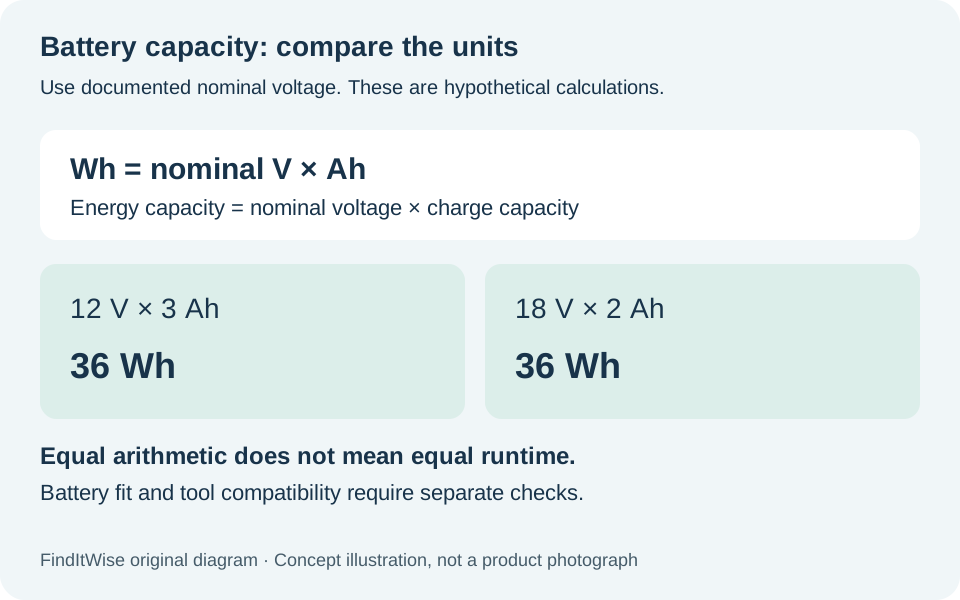
The calculation is Wh = V × Ah. As a deliberately hypothetical example, 12 nominal volts multiplied by 3Ah gives 36Wh. Eighteen nominal volts multiplied by 2Ah also gives 36Wh. These are illustrative rated-energy calculations, not statements that any two physical batteries perform identically.
The example shows why Ah cannot be compared in isolation across voltage systems. Equal energy arithmetic also does not make the packs interchangeable: the connection and tool compatibility remain separate questions.
Keep nominal and maximum voltage consistent
The DeWalt DCB203 record identifies a 2Ah battery and explains that its 20V MAX designation refers to maximum initial voltage without a workload; nominal voltage is 18V. Using the documented nominal figure gives 18 × 2 = 36Wh as a label-based calculation.
Multiplying the maximum label by the same capacity would produce a different number because it changes the voltage basis. That is not evidence of additional measured energy. For the detailed branding question, see 18V versus 20V MAX. Here the key step is to keep the inputs consistent and state where they came from.
A capacity calculation is not a runtime promise
Neither the Ah label nor the calculation above establishes how many holes your drill will make or how many minutes a saw will run. Those outcomes need evidence for the actual tool, load and test conditions. We do not turn a rated-energy comparison into a runtime ratio.
The same limit applies to power claims. A larger Wh number describes more rated energy on the stated basis, not a measured fastening speed or a guarantee that a tool delivers a particular output. If a buying decision depends on tool performance, look for model-specific evidence rather than extending the label arithmetic beyond what it shows.
Do not read charger timing from battery capacity alone
A battery capacity is also not a charging-time specification. Check the manufacturer’s information for the exact charger-and-pack combination instead of treating a larger pack as proof of a particular wait. This article supplies no charging-time estimate or charger compatibility claim.
Write down the exact battery and charger identifiers before comparing offers. A package with two batteries changes the quantity received; it does not change the per-pack capacity printed on either one. Our DeWalt battery package guide covers that purchase question with documented examples.
Record the labels before deciding
A useful comparison sheet has separate fields for model, nominal voltage, Ah, manufacturer-stated Wh if available, and tool/charger compatibility. Mark a calculated Wh value as calculated and keep its inputs beside it. Leave a missing field unresolved instead of borrowing a value from a similar-looking pack.
Use that record to understand the offer, then assess whether the battery solves a real equipment need. These unit conversions do not establish current stock, seller authenticity, warranty terms, safe substitution or suitability for transport. They simply prevent a comparison built on mismatched labels.

Common questions
Can I compare Ah without checking voltage?
Ah alone does not establish relative energy across different voltage systems. Include the documented nominal voltage or manufacturer Wh rating.
Is the 36Wh example a measured DCB203 test?
No. It is the stated nominal voltage multiplied by capacity, explicitly labelled as a calculation rather than a measured result.
Sources & references
- Anker capacity units and energy calculation — accessed October 19, 2026
- DeWalt DCB203 capacity and nominal/maximum voltage definition — accessed October 19, 2026